Upper Elementary (3rd-5th Grades)
LITERACY
Reading and writing flourish in Valley's Upper School. By third grade, students are transitioning from “learning to read” to “reading to learn,” and the curriculum nurtures this leap in independence. In Reader’s Workshop, children dive into rich literature – from novels to nonfiction – and discuss their ideas in small, flexible groups, honing comprehension strategies as they go. They enjoy read-alouds and literature circles that spark insight and critical thinking. In Writer’s Workshop, Upper Schoolers learn to craft everything from personal narratives to persuasive essays, following the full writing process of drafting, revising, and publishing their work. Teachers also weave in Word Study: fun explorations of spelling patterns, grammar rules, and vocabulary to strengthen students’ language skills. By integrating these elements, Valley School’s literacy program ensures that each child becomes a confident reader and writer who not only masters fundamentals like cursive and keyboarding, but also finds their own voice and joy in literacy
Reading and writing flourish in Valley's Upper School. By third grade, students are transitioning from “learning to read” to “reading to learn,” and the curriculum nurtures this leap in independence. In Reader’s Workshop, children dive into rich literature – from novels to nonfiction – and discuss their ideas in small, flexible groups, honing comprehension strategies as they go. They enjoy read-alouds and literature circles that spark insight and critical thinking. In Writer’s Workshop, Upper Schoolers learn to craft everything from personal narratives to persuasive essays, following the full writing process of drafting, revising, and publishing their work. Teachers also weave in Word Study: fun explorations of spelling patterns, grammar rules, and vocabulary to strengthen students’ language skills. By integrating these elements, Valley School’s literacy program ensures that each child becomes a confident reader and writer who not only masters fundamentals like cursive and keyboarding, but also finds their own voice and joy in literacy
MATH
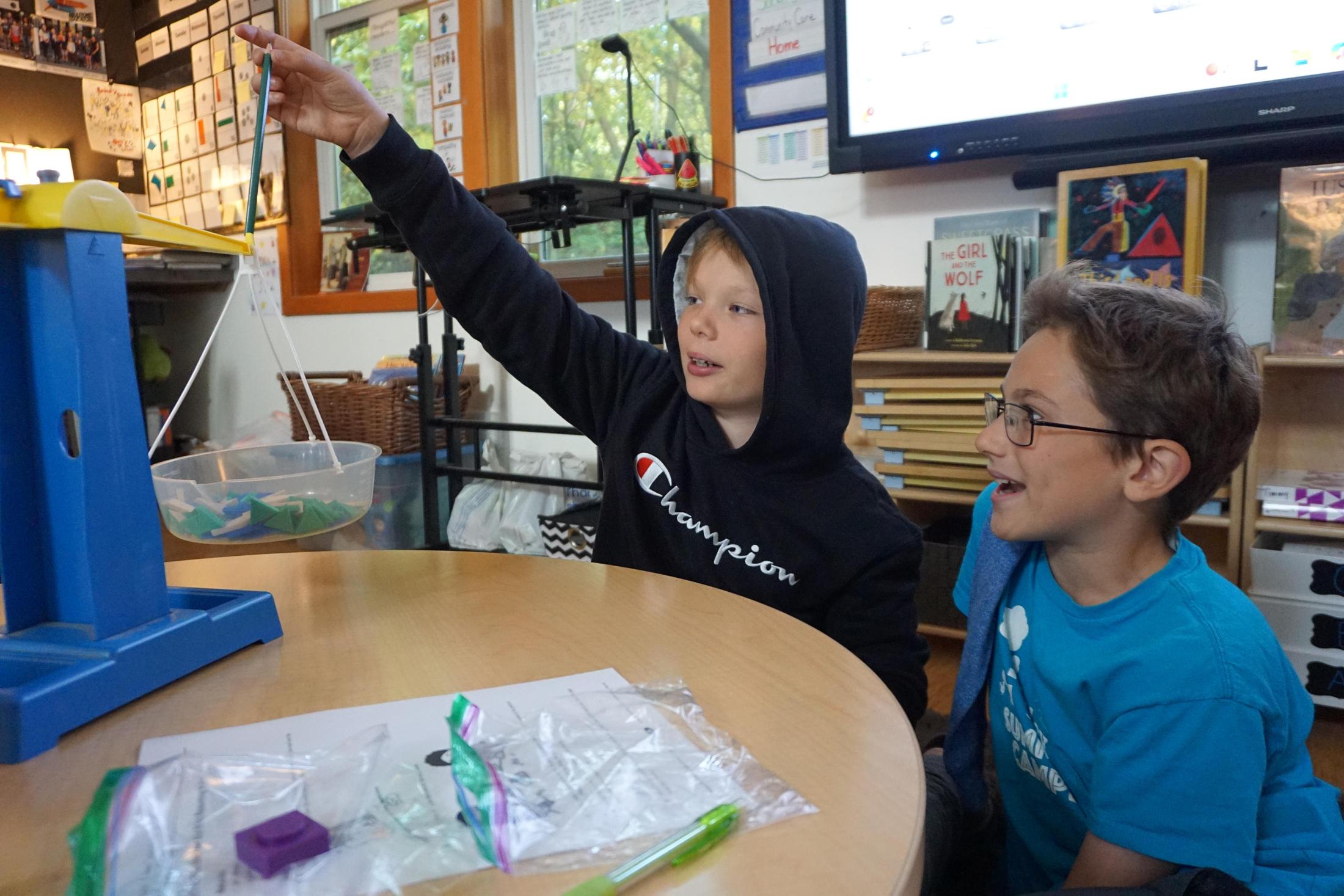
Math in Valley’s Upper School is both challenging and fun. The program builds strong skills in all the elementary math domains – from number sense and algebraic thinking to geometry and data – while keeping students engaged through a hands-on, collaborative approach. Teachers follow the Bridges in Mathematics 3rd Edition curriculum which emphasizes understanding why math works, not just getting the answer. A typical day might begin with a whole-class exploration of a new concept, but soon you’ll find students breaking into small groups and stations. It’s common to see kids playing math games in class, laughing and strategizing as they reinforce their skills. These games and activities are often tiered with different levels of challenge, so every child is appropriately stretched while having fun. Valley’s teachers also use flexible small-group lessons to target specific skills and provide extra practice or extensions as needed. This intentional mix of direct instruction, exploration, and play ensures students gain computational fluency and confidence. Just as importantly, students learn to talk about their mathematical thinking – explaining their strategies and solving problems collaboratively – so they grow into problem-solvers who truly understand math.
Math in Valley’s Upper School is both challenging and fun. The program builds strong skills in all the elementary math domains – from number sense and algebraic thinking to geometry and data – while keeping students engaged through a hands-on, collaborative approach. Teachers follow the Bridges in Mathematics 3rd Edition curriculum which emphasizes understanding why math works, not just getting the answer. A typical day might begin with a whole-class exploration of a new concept, but soon you’ll find students breaking into small groups and stations. It’s common to see kids playing math games in class, laughing and strategizing as they reinforce their skills. These games and activities are often tiered with different levels of challenge, so every child is appropriately stretched while having fun. Valley’s teachers also use flexible small-group lessons to target specific skills and provide extra practice or extensions as needed. This intentional mix of direct instruction, exploration, and play ensures students gain computational fluency and confidence. Just as importantly, students learn to talk about their mathematical thinking – explaining their strategies and solving problems collaboratively – so they grow into problem-solvers who truly understand math.
SOCIAL STUDIES
The Upper School Social Studies program immerses students in both local history and broader world themes. In third through fifth grade, children learn about Washington State, Seattle’s community and geography, early U.S. history, and important global issues. Lessons often connect with other subjects – for example, students might read stories or create art related to the culture or time period they are studying. Teachers also weave in student interests; if a particular topic sparks curiosity, the class may dig deeper, which keeps learning exciting and relevant. Throughout these units, students move beyond just memorizing facts and begin to think like young historians and community leaders, developing critical thinking as they consider problems and solutions from the past and present.
Units frequently culminate in an interactive project or event that students help create – for example, a class might transform their room into a museum exhibit or perform a play to showcase their learning. Field trips and guest speakers also bring topics to life; one week, students might visit a local museum or interview a community helper to connect their classroom lessons with the real world. Upper Schoolers often take the lead in service projects tied to their curricular work as well, brainstorming ways to help their community and then working together to make a difference. These hands-on experiences ensure that social studies is not just about studying history and culture, but also about inspiring students to become thoughtful, active citizens.
The Upper School Social Studies program immerses students in both local history and broader world themes. In third through fifth grade, children learn about Washington State, Seattle’s community and geography, early U.S. history, and important global issues. Lessons often connect with other subjects – for example, students might read stories or create art related to the culture or time period they are studying. Teachers also weave in student interests; if a particular topic sparks curiosity, the class may dig deeper, which keeps learning exciting and relevant. Throughout these units, students move beyond just memorizing facts and begin to think like young historians and community leaders, developing critical thinking as they consider problems and solutions from the past and present.
Units frequently culminate in an interactive project or event that students help create – for example, a class might transform their room into a museum exhibit or perform a play to showcase their learning. Field trips and guest speakers also bring topics to life; one week, students might visit a local museum or interview a community helper to connect their classroom lessons with the real world. Upper Schoolers often take the lead in service projects tied to their curricular work as well, brainstorming ways to help their community and then working together to make a difference. These hands-on experiences ensure that social studies is not just about studying history and culture, but also about inspiring students to become thoughtful, active citizens.